
In the Janaury 2003 issue:
About ILISA: Meet our Program Director
Costa Rica: Its Land and Its People, Part I
Improvements in Service
Links to previous issues:
Meet Xinia Sanahuja, Spanish Program Director
 Xinia Sanahuja started teaching Spanish as a second language in Michigan in 1981. Since then she has taught with numerous language schools in Costa Rica. In January 1999 she rejoined ILISA’s staff as our Spanish Program Director after a 4 year absence.
When she started teaching, the emphasis of language teaching had already shifted from the traditional “grammar-translation” teaching styles, to those which emphasized repetition and oral practice. Xinia points out, “there have been enormous changes in methods in the last twenty years.” Communicative methods now predominate. In addition, there is a greater awareness of the interconnectedness of language and culture, and of the differences in learning styles of different types of students, for example, “heritage-speakers” (people whose cultural background is the same as the language studied) versus people who have never been exposed to the language and culture. In addition, there are “the learning process for people learning Spanish as a second language is vastly different than for people who already speak two or more languages.” Since ILISA keeps groups small, these differences can be taken into account.
“I believe that for adults, a combination of different methods should be used and that, most importantly, adults, much more than children, learn from their errors. A lot of people don’t understand what I mean when I say that errors are very positive. In fact, adults can learn a lot from things that they don’t do well. I try to help our teachers understand how to take advantage of errors by giving the student very positive feedback so that they can learn from the mistakes that they make. Errors are a very positive part of the language learning process.”
In her work as Program Director, Xinia has a great deal of contact with students who come to her with questions or problems regarding their classes. In some cases, a move to a class at a different level does the trick. Sometimes students’ fear of making mistakes gets in the way of their progress; she tries to help them overcome that fear so they become more comfortable speaking in class. In other situations, she can help teachers choose materials and methods which are most helpful for their particular students. Problem-solving is the aspect of her job which she enjoys most because it demands that she use her academic experience, interpersonal skills and creativity.
Xinia recommends that students considering an immersion program start the process with an open mind, recognizing that they will get something positive out of the experience and that they will always learn something, especially about themselves. She adds, “I admire anyone who starts the process of learning another language. It shows their openmindedness and interest in communicating with other people.”
Manuel Antonio National Park: Something for Every Taste
The beautiful beach of Manuel Antonio is one of the favorite weekend spots for ILISA students. Manuel Antonio offers a lot more than just white sand and palm trees. The National Park of Manuel Antonio is right on the beach and in it live a wide variety of animals that are native to Costa Rica. Upon entrance to the park iguanas, sloths or white-faced monkeys might welcome you.
Once you are in the National Park you have the option of choosing which trail you want to hike. One of the best trails is the one that leads you to Cathedral Point. This point offers you a beautiful view of the Pacific Ocean. While you are hiking through this beautiful jungle don’t forget to look above you for families of monkeys that live in the park.
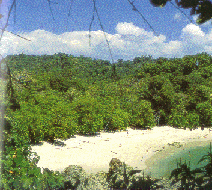 Another option for you is to take advantage of the clear water and go snorkeling. The water is warm and there is plenty to see. The current is not too strong so it also makes for nice swimming. Anna Davis, ILISA’s enrollments coordinator, says, “There’s no better place to spend a relaxing weekend.”
In Manuel Antonio there are numerous hotels that fit any budget. You can chose from $5 a night cabinas to $250 a night resorts. You will also have the opportunity to chose from a variety of restaurants from typical Costa Rican food, to fresh seafood, to delicious Italian pasta and pizza. After dinner you can have a drink at one of the numerous bars in Quepos or go dancing at Arco Iris. This is a popular local hang out where you will have the chance to dance merengue and salsa with ticos!
Costa Rica: Its Land and Its People, Part I
Costa Ricans are proud of their special country. In 1949 it became the first in the mainland Americas to abolish its army-a fact that many Ticos, as Costa Ricans call themselves, attribute to their tendency to settle disagreements peacefully through dialogue and compromise. They boast of 93 percent literacy and, when they had an army, liked to tell visitors, “We have more teachers than soldiers.” Their life expectancy is the highest in Latin America thanks to years of government spending on clean piped water, vaccinations, nutrition, and health education as well as to a health insurance program that covers almost everyone.
For half a century Costa Rica’s presidents have come to office through honest elections. The incumbent party rarely wins-largely a consequence of Ticos’ reluctance to let any one person, party, or other group become too powerful.
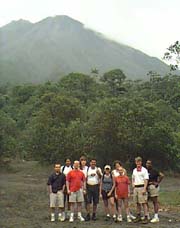 Costa Rica’s long history of peace, stability, and emphasis on education has attracted numerous foreign investors. This reputation, along with the country’s great natural beauty, also attracts over half a million tourists each year. Those who stay for more than a few weeks will find that much of its reputation is well deserved. They may also learn about the country’s problems, for Ticos do not hesitate to complain as well as boast to a trusted listener.
The third smallest country in the mainland Americas, Costa Rica has an area of 51,000 square kilometers (20,000 square miles), or twice the size of Vermont. It is located in the narrow isthmus of southern Central America between Nicaragua and Panama. Its maximum length from northwest to southeast is 484 kilometers; its minimum width from the Pacific Ocean to the Caribbean Sea, 119 kilometers.
Despite its small size, Costa Rica has an enormous range of topography and climates. Though it lies only ten degrees north of the equator, temperatures vary greatly from sultry lowlands to cold mountaintops. Rainfall and humidity vary with nearness to the coasts as well as altitude and the direction of prevailing winds. These climatic variations help explain the great diversity of Costa Rica’s flora and fauna. So does its “strategic position near the junction of two great continents, biologically quite different, from each of which it has received large contributions.”
Mountain ranges run the length of the country like a backbone. One volcanic range, the Cordillera de Guanacaste, begins in the Northwest near Nicaragua and connects with another, the Cordillera de Tilarán. This range runs southeastward and meets the volcanic Cordillera Central, which ends near the center of the country. Five of the 112 volcanoes in these ranges were active in 1998. A higher nonvolcanic range, the Cordillera de Talamanca, runs from the country’s center to its southeastern border and on into Panama and Colombia. Much of it is still covered with virgin cloud forests of live oaks up to 600 years old. Its highest parts, treeless, tundra-like paramo, have frost but no snow.
As in all of Central America, the Caribbean slope (or Atlantic slope, as Ticos call it) is mostly gradual and gentle, the Pacific slopes mostly steep and hilly. In the Northeast near the Caribbean and in the southwestern lowlands are some of the primary forests that still cover about a quarter of the country’s area despite extensive clearing for pasture and farming. A few patches of tropical dry forest remain on hills in the Northwest; there are also flat areas covered with -reat expanses of cotton and dry rice fields and cattle pastureforested until a century ago.
Two out of three Ticos live in the Valle Central, or Central Valley; they are especially concentrated in the relatively flat Meseta Central, or Central Plateau. The Central Valley is formed where the two chief mountain ranges, the Cordillera Central and the Cordillera de Talamanca, nearly meet. Altitudes on the valley floors range from about 600 to 1,500 meters. 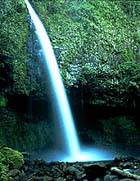
The Valle Central is not, strictly speaking, a valley any more than the Meseta Central is a plateau, but both terms are traditional and, in everyday speech, interchangeable. The Meseta is actually two small sections of the Central Valley roughly between Alajuela on the western side of the mountains and Cartago to the east. In and near the Central Valley, as well as in the valley of El General to the southeast, the rugged and fragmented terrain strongly affects who interacts with whom. The slopes are a patchwork of forest, cropland, and pasture; the lush green valleys are laced with streams.
Located at the juncture of two tectonic plates, Costa Rica experiences frequent earth tremors, which range from imperceptible shivers through sacudidos (shakings-up) and temblores (tremblings) to full-blown terremotos (serious quakes). Although the National University’s seismograph detected 3,000 tremors in 1991, residents felt very few; only one was a terremoto; it caused serious damage along the Caribbean coast.
Weather varies with altitude, time of year, and exposure to ocean winds. Daytime temperatures in the Central Valley range from 60 to 85*F, averaging about 75′ (23’C), and tourism promoters rhapsodize about “the land of eternal spring.” But it is sometimes so chilly, especially in the evening, that sweaters and blankets are welcome.
Costa Rica has a modified version of a monsoon climate. In most regions there are two fairly distinct seasons, called invierno and verano, whose usual English translations as “winter” and “summer” are misleading. Rainfall varies greatly from the constantly humid Caribbean slopes to Guanacaste with its long and severe dry season. In much of the country invierno, the rainy season, lasts from May to November. Sunny mornings are usually followed by overcast skies and a brief downpour, or perhaps by a thunderstorm or rain that may continue all afternoon.
About mid-November strong north winds usher in the dry verano for the Central Valley and the Pacific slope but bring more rainy spells to the Caribbean side of the mountain watershed. Most wooded areas stay green all year, but during verano pastures turn brown, dust blows from fields and dirt roads in central and western Costa Rica, and smoke fills the air as farmers burn stubble and brush. Although many prefer the dry season, during its final warm months they grow as eager for the first downpour as the parakeets flying overhead in screeching flocks-pleading, say the Ticos, for the rains to begin.
Rain is so much a part of Costa Rican life that Ticos use at least eight words to distinguish various types, from pelo de gato (misty “cat’s fur”) and garua (drizzle) to an aguacero (downpour) and a temporal (steady rain lasting several days, most common in September and October). Rain replenishes the water supply, irrigates crops, feeds the rivers that supply hydroelectric energy and in a few areas are the only travel routes, and frequently results in destructive flooding.
 Costa Rica has long been a botanist’s paradise. There are more varieties of plants in this tiny land than in all of the United States east of the Mississippi: over 1,500 distinct species of trees and over 6,000 kinds of flowering plants, including 1,000 species of orchids.
Animal life is also profuse. Some 830 species of birds have been identified, more than in all of North America north of Mexico. The National Biodiversity Institute estimates that Costa Rica is home to 350,000 species of insects. Acre for acre the lowland rain forests support a greater variety of animal and vegetable life than any other area of the earth’s surface.
Naturalists lament that Costa Rica is no longer the paradise of a few decades ago. Nearly a third of the nation’s territory is protected-at least on paper-in public and private parks and reserves. But many forests have been reduced to shreds and patches; giant trees have been felled and burned to make pasture and banana plantations; and in hilly areas, soil erosion has soon followed. Bird and animal populations have dwindled along with their shelter. Twenty-six species of animals were on the endangered list in 1996. During the 1980s one species, the famous golden toad of Monteverde’s cloud forests, vanished from the area and is now reportedly extinct.
Excerpt from: The Ticos: Cultural and Social Change in Costa Rica, published by Lynne Rienner Publishers.
ILISA Improves Services for Clients
For added convenience, ILISA has just installed a fax line which is toll-free from the US and Canada. To fax in your registration, credit card authorization form or request for information, dial 1-888-803-2252.
We also invite you to visit our new website at http://www.ilisa-cr.com/welcome or use the navigational tools on the menu bars above. While you’ll still find a few broken links and forms, we hope you’ll like the new look and will find it easy to navigate. Please let us know what you think.